Blanket mortgages in New York City: how to read a portfolio loan in ACRIS (and why brokers should care)
One loan, many parcels. How blanket mortgages and portfolio loans appear in NYC public records, what a partial release signals, and how Circlemark surfaces 42,000 active portfolio loans across the four ACRIS boroughs.
By Circlemark · · 6 min read · Figures as of Aug 26, 2026
Key numbers. Of the active commercial loans we track in New York City, 42,779 are secured by more than one tax lot — blanket mortgages and portfolio loans. Most are small: 35,133 cover two to five lots. But 2,017 cover between 21 and 100, and 944 cover more than a hundred. The largest single instrument in the city is a $330 million Wells Fargo mortgage recorded in 2019 against 6,352 lots — the Parkchester condominium complex in the Bronx. Every one of those loans has exactly one maturity date, and when it arrives, every parcel under it is in play at once.
This post is about how those loans show up in the public record, how to read them without getting the amount wrong, what a partial release is really telling you, and how we surface them.
What a blanket mortgage is, and why New York has so many
A blanket mortgage (in the trade, often "portfolio loan" or "cross-collateralized loan") is one mortgage secured by several properties. The lender takes one lien across all of them; the borrower makes one payment; and the loan documents almost always include a release clause — the borrower can sell one property out of the lien by paying down an allocated amount, typically well above that property's pro-rata share of the balance.
New York produces more of these than most markets, for two reasons that have nothing to do with each other:
- Ownership is concentrated. Families and operators that own eight walk-ups in Bushwick, or a dozen mixed-use buildings along one avenue, refinance them together. A 71-parcel Brooklyn portfolio under one lender is unremarkable here.
- Condominiums are separate tax lots. A lender financing an investor's six units in one building records one mortgage against six borough-block-lots. Technically that is a blanket mortgage; economically it is one building.
Both look identical in the Master file: one row, one amount.
How a portfolio loan appears in ACRIS
ACRIS splits every recorded document across several files. The Master file holds one row per document — type, amount, dates, recording borough. The Legals file maps that document to the tax lots it encumbers: one row per lot. A blanket mortgage is therefore a single Master row with N Legals rows.
That structure creates the first trap. Look at any one parcel — as a property-centric tool does — and you will find the full loan amount attached to it. A $90 million mortgage across 2,573 units (another Parkchester instrument, this one from 2005) looks, parcel by parcel, like 2,573 separate $90 million loans. Sum a neighbourhood that way and you invent tens of billions of dollars of debt.
The only correct unit is the document. We ingest by document ID, attach every lot the Legals file gives us, and carry the loan amount once. The search grid shows a row per parcel because brokers work by address, but each row knows it belongs to a portfolio and links to its siblings:
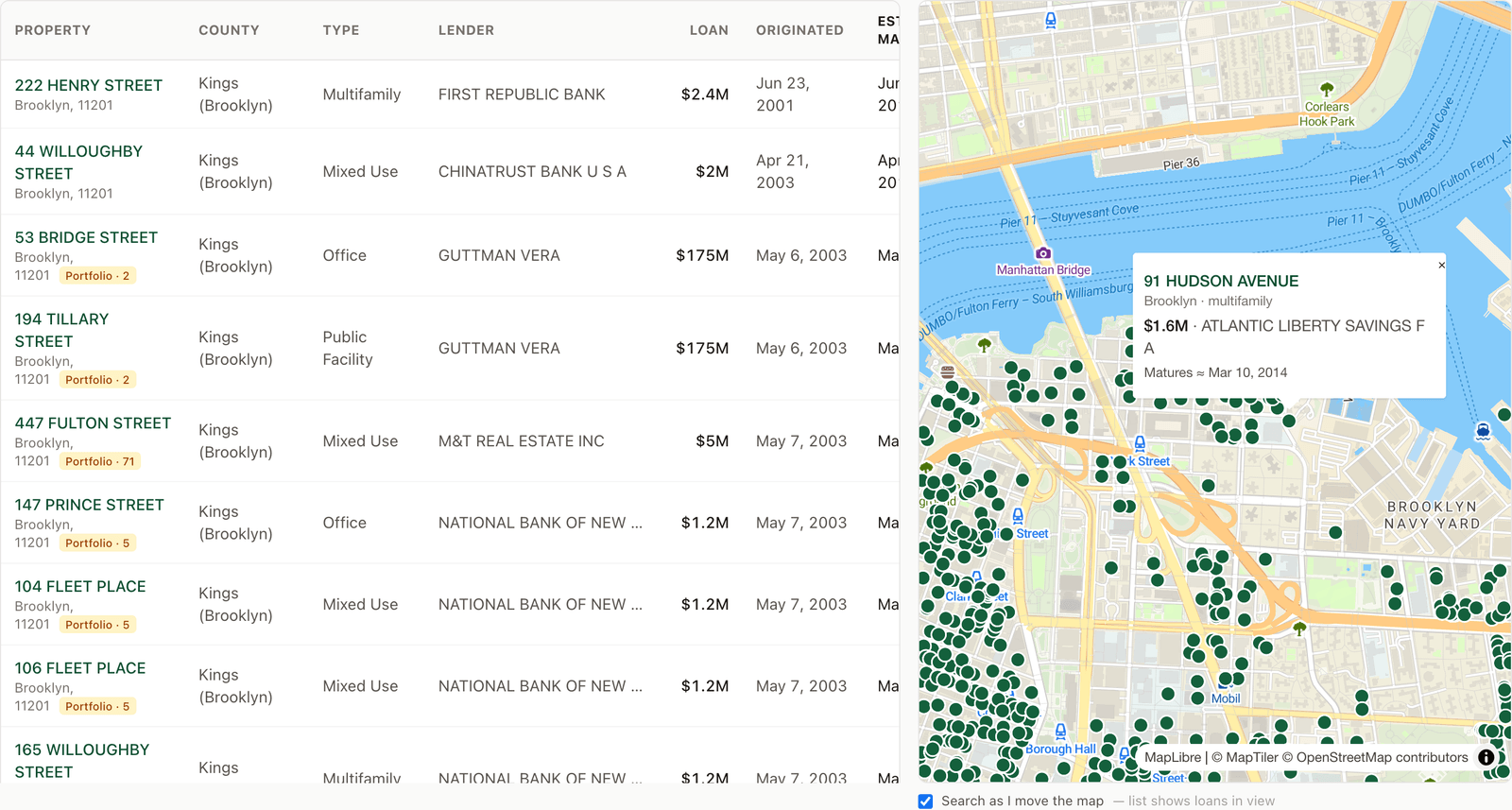 The results grid marks portfolio rows with the parcel count (here, a 71-parcel Brooklyn portfolio and several 5-lot loans). The map pane shows the same loans; clicking a point opens the loan.
The second trap is the one every New York loan has: the recorded set. A portfolio refinance is usually a CEMA — a gap mortgage plus a consolidation agreement — and the consolidation, not the gap note, carries the loan amount (why New York loans are recorded this way, and what it does to maturity data). We classify the recorded set before we count anything, so a portfolio's amount is the consolidated amount, not the new-money slice.
Reading a portfolio loan on the property page
On a property, a portfolio loan shows its badge, the full list of the other parcels it secures, and — where we have it — the maturity read from the recorded document:
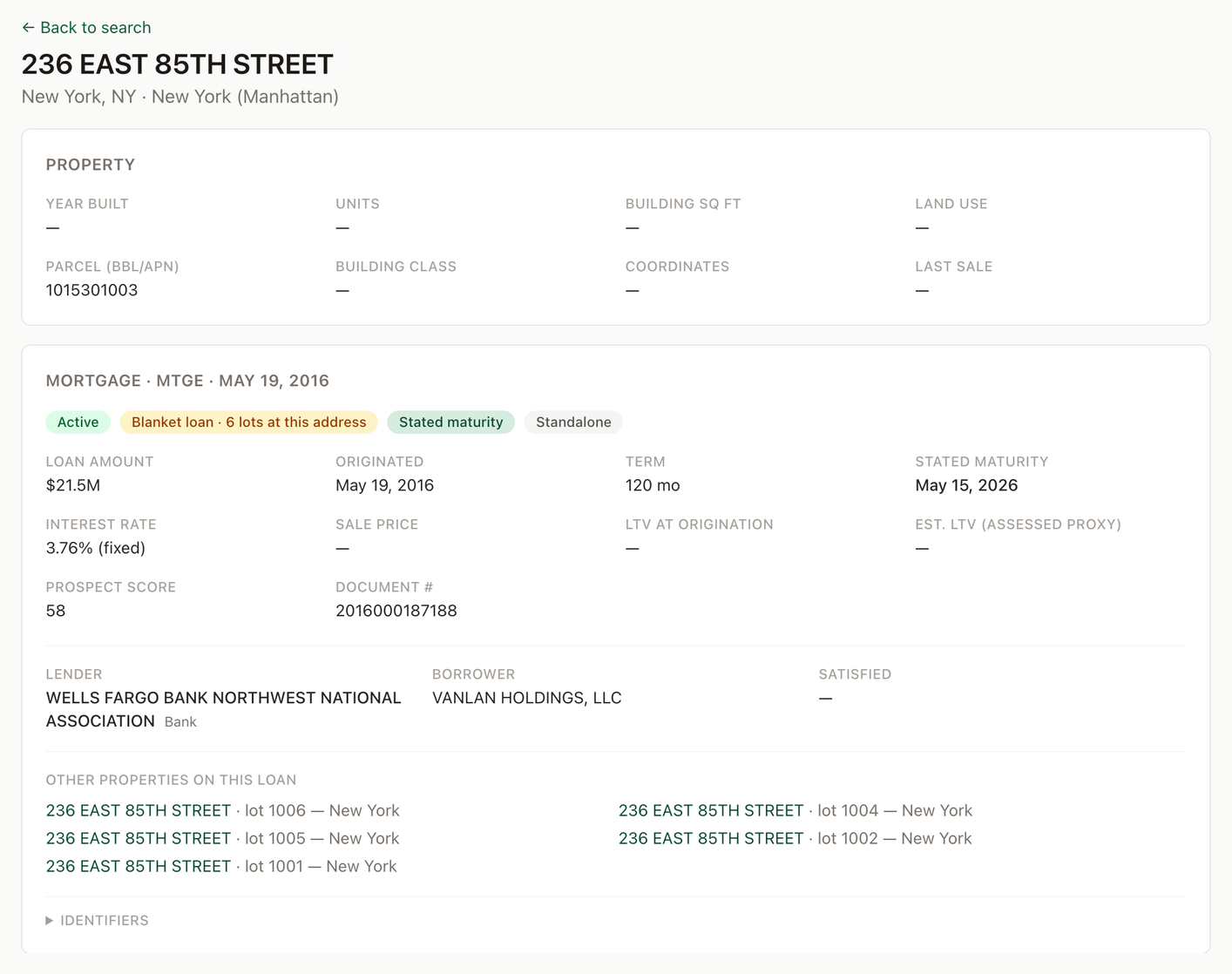 A 2016 mortgage securing six condominium lots at one Manhattan address. The maturity and rate were read from the recorded instrument, so they render as stated facts with the document cited; a modelled maturity would render with an ≈ marker instead.
Two details on that page matter more than they look:
- "Blanket loan · 6 lots at this address" versus "Portfolio loan · N properties". We distinguish several lots in one building from several buildings, because the broker conversation is different: one is a condo investor, the other is an operator with a portfolio decision to make.
- The tax lot next to each sibling. Six condo units share a street address; without the lot number the list is six identical lines.
What a partial release is actually telling you
When one property leaves a blanket lien, the lender records a partial release (PREL in ACRIS; PSAT for a partial satisfaction). We hold 117,693 of them across the four boroughs. A naive pipeline treats a release like a satisfaction and marks the loan paid off — we did, briefly, until the data corrected us. A partial release is the opposite of a payoff signal for the loan: the loan is alive and the borrower is actively managing the portfolio.
For the parcel that was released, though, it is one of the clearest transaction signals the recorder offers. A partial release almost always accompanies a sale or a standalone refinance of that property. If you cover a submarket, a partial release on a portfolio you know is worth a call — to the buyer, to the seller, and to whoever now has one fewer asset under the old loan and a maturity still coming.
We record every partial release as an event on the loan, keep the loan active, and — this is the part we are still building out — will surface the released parcel as its own signal.
Why portfolio loans are worth more of a broker's time
Three reasons, in order of importance:
- Leverage. One maturity, one decision, many assets. A refinancing conversation about a 20-parcel portfolio is one relationship and one process; twenty single-asset conversations are twenty of each.
- Optionality. Portfolio owners at maturity have more moves than single-asset owners: refinance the whole, sell some and refinance the rest, split the portfolio between lenders. Each move needs a broker.
- Under-coverage. Because the public record is parcel-centric and most tools are too, portfolio loans are systematically misread — double-counted, mis-sized, or attributed to a single address. The operators who own them get fewer, worse-informed calls than the loan size would suggest.
Where the maturities are
Portfolio or not, the question is when. Here is the distribution of active NYC commercial loans by best-available maturity year — stated where we have read it from the document, otherwise the modelled term for the lender type (five years for banks, three for debt funds, ten for agency and CMBS):
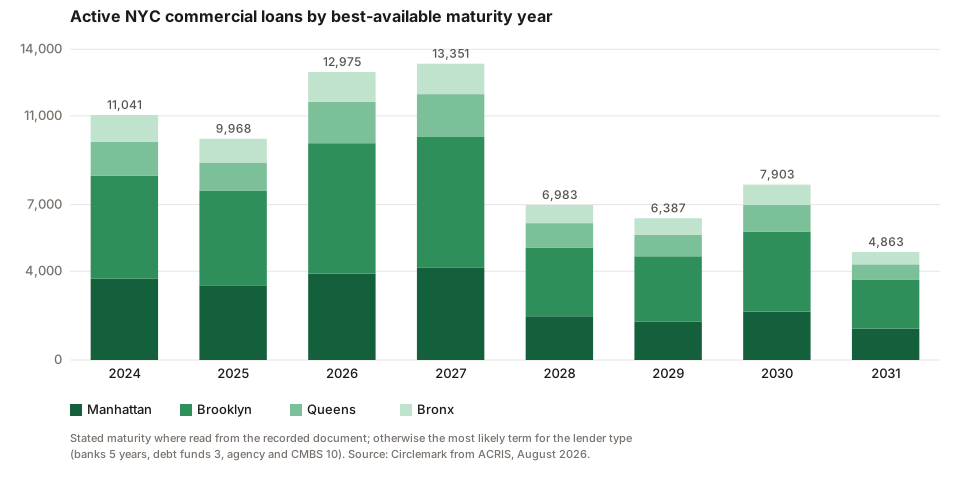 2026 and 2027 are the peak years, driven by 2016–2017 originations and 2021–2022 bank loans on five-year terms. Modelled dates carry an ≈ in the product; the chart mixes stated and modelled.
Known limitations
- We identify a portfolio by the lots on the recorded instrument. Loans that are cross-collateralized by separate mortgages on separate parcels (one per property, cross-defaulted in the loan agreement) look like unrelated loans in the recorder, and we do not yet link them by borrower.
- Partial releases are recorded as events on the loan but not yet as a standalone signal on the released parcel.
- PLUTO, the assessor dataset we use for building attributes, keys on the billing lot; individual condo lots often show no year built or square footage.
- The Parkchester-scale instruments (thousands of units) are real, but a maturity on them is a corporate event, not a broker lead.
If you broker in New York and want the portfolio loans in your submarket by maturity window, the search is open — filter by borough, size and maturity, and the portfolio badge does the rest. Method, provenance tiers and the guards we run weekly are in the methodology.
Frequently asked questions
- What is a blanket mortgage in commercial real estate?
- A single mortgage secured by more than one property — several buildings, or every tax lot in one building. The lender holds one lien across all of them, the borrower makes one payment, and individual properties can usually be sold out of the lien through a partial release once an allocated amount is paid down.
- How can I tell in ACRIS that a mortgage covers multiple properties?
- In the Real Property Legals file, one document ID maps to several borough-block-lot (BBL) records. The Master file shows only one row and one amount, so a property-by-property view will attribute the whole loan to whichever parcel you happen to look at. You have to group by document ID.
- What does PREL (partial release) mean in ACRIS?
- A recorded partial release removes one or more parcels from a blanket mortgage's lien while the loan continues on the rest. It is not a payoff. In practice it almost always means one of the portfolio's properties was sold or refinanced on its own — a transaction signal on that specific parcel.
- Do portfolio loans mature differently from single-property loans?
- No — one instrument, one maturity. But the maturity affects every parcel at once, so a single refinancing decision moves a whole portfolio. That is what makes them disproportionately valuable to brokers: one conversation covers many assets.
- Why does a loan on one building show as a portfolio of six 'properties'?
- Condominiums. Each unit is its own tax lot in New York, so a lender financing six units in one building records one mortgage against six lots. We label these as a blanket loan at one address rather than a multi-building portfolio, and show the tax lots so they are distinguishable.
Sources
Read next
- How we monitor NYC commercial mortgage maturities for brokers in 2026 (and why ACRIS makes it hard)
Where commercial mortgage maturity data actually comes from, why New York City's public records don't contain a maturity date, and how Circlemark turns recorded documents into a verified, weekly-refreshed list of loans coming due.